
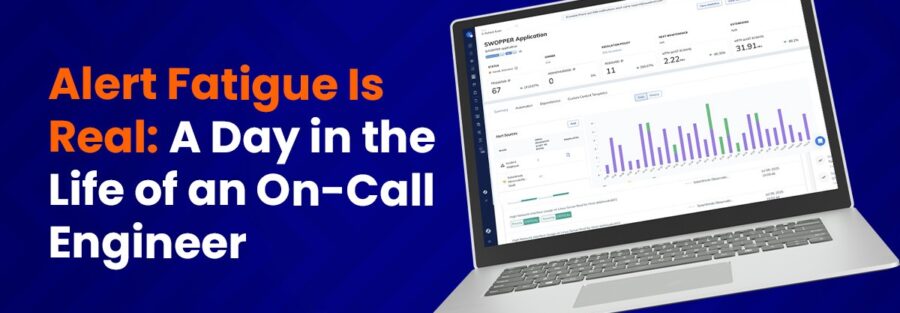
It’s 3 AM. Your phone vibrates on the nightstand. Half-asleep, you reach for it, and you find… Twelve new alerts. Database latency. Network timeout. Memory exhaustion.
Your heart pounds. Which one is the real problem? Which one can wait? Where do you even start?
If you’re an on-call engineer managing IT infrastructure for any business, this isn’t fiction. It’s a normal workday.
The Problem Nobody Warned You About
You just started your first on-call rotation. You thought you were prepared. You had memorized runbooks, escalation contacts, and monitoring dashboards.
What you didn’t have was a way to cut through the noise.
On your second shift, you received 89 alerts in one night. Eighty-nine?! You acknowledged them all, tried to investigate each one, and by morning, you were not even done. The real issue? Only four alerts actually required action. The other 85 were duplicates, false positives, or symptoms of those same four problems.
By week three, something dangerous happened: you started ignoring alerts. Your brain had learned to tune them out just to survive.
This is called alert fatigue, and it’s not just annoying – it’s dangerous. Studies show that 28% of critical alerts get missed because teams are drowning in noise. When everything screams for attention, nothing gets it.
Why Traditional Incident Response Fails
Here’s what incident response looks like for most Nigerian IT teams:
- Multiple monitoring tools send alerts to different places (email, Teams, SMS, phone calls)
- Someone gets woken up and tries to figure out what’s actually broken
- They spend 20 minutes digging through logs and dashboards to understand the problem
- They manually notify other team members who might need to help
- Everyone works in silos, duplicating effort and missing context
- When it’s finally resolved, there’s no clear record of what happened or how it was fixed
This isn’t a process. It’s controlled chaos.
And for businesses already dealing with power fluctuations, connectivity challenges, and limited resources, this chaos is unsustainable.
What If There Was a Better Way? Understanding Incidence Response
Now, Incident Response is the structured approach to handling IT incidents – from the moment something breaks until it’s fully resolved and documented.
The first minutes of any incident are critical. Research shows that Mean Time to Acknowledge (MTTA), how quickly someone starts working on a problem, directly impacts how long systems stay down.
The faster you understand what’s broken and who needs to fix it, the faster your customers get back to business.
But speed without clarity creates more problems. You need the right information reaching the right people at the right time.
That’s where SolarWinds Incident Response changed everything for teams.
So, What Exactly Is SolarWinds Incident Response?
In simple terms, SolarWinds Incident Response is a central command centre for handling incidents, from the very first alert to full resolution.
It brings alerts, people, processes, and communication into one clear system of action.
Instead of jumping between tools, chats, and spreadsheets, teams get one place to:
- See what’s happening
- Understand what matters
- Respond quickly and confidently
Think of it as air traffic control for your IT incidents. It doesn’t fly the planes, but it makes sure they don’t crash into each other.
How It Actually Works
- AI-Powered Alert Correlation
Remember those 89 alerts that woke you up at 3 AM? SolarWinds uses artificial intelligence to understand which alerts are related.
Instead of 89 separate problems screaming for attention, you get intelligent summaries like: “Network connectivity issue affecting multiple services – likely router failure in primary data centre.”
Suddenly, you know exactly where to look. Companies using this approach report reducing incoming alerts from thousands to hundreds through smart deduplication.
- Intelligent On-Call Routing
The system knows who’s on-call, what their expertise is, and how urgently they need to be notified.
Critical database issue at 2 AM? Phone call to your database specialist.
Minor warning during business hours? Slack message to the team channel.
You can configure it based on your team’s structure and preferences. No more calling people one by one or hoping someone sees the message.
- Context That Speeds Up Resolution
When an alert comes in, it doesn’t just say “Database slow.” It tells you:
- Which specific database and service is affected
- Current performance vs. expected performance
- Likely causes based on similar past incidents
- Suggested actions to resolve it
- Who else might need to be involved
This context cuts Mean Time to Resolution (MTTR) dramatically.
Instead of spending 20 minutes investigating, you’re acting within lesser minutes.
- Built-In Collaboration
Complex incidents need multiple people working together. It connects directly with SolarWinds Observability (SaaS and Self-Hosted) and over 200 other tools, creating dedicated incident channels where everyone sees the same information in real time.
Every action is logged automatically. Every decision is documented. When your CEO asks what happened, you have a complete timeline – not scattered Teams messages and half-remembered phone calls.
What This Means for IT Teams
Let’s paint a realistic picture. You are managing infrastructure for a mid-sized Nigerian company. You have local servers, cloud services on Azure, and monitoring tools tracking everything.
Without proper incident response, each tool sends alerts independently. Your devices become a battleground.
With SolarWinds Incident Response:
- All alerts funnel into one platform that filters out noise
- Related alerts get grouped automatically (one network issue doesn’t create 30 notifications)
- Your team gets notified based on expertise and availability
- Everyone works from the same information
- You track service reliability targets before you breach them
The Questions You Are Probably Asking
“Will this replace our existing monitoring tools?”
No. It works with them. SolarWinds Incident Response integrates with your current monitoring setup – it doesn’t replace it. Think of it as the conductor making all your tools work together instead of competing for attention.
“Can it handle our connectivity challenges?”
Yes. The platform is cloud-based, so it keeps working even when your local infrastructure doesn’t. Mobile notifications ensure you stay informed during connectivity issues. And because it dramatically reduces alert volume, you’re not burning data with redundant notifications.
“How quickly will we see results?”
Companies report seeing impact within weeks. The AI learns your environment over time, getting smarter about which alerts actually need human attention and which can be filtered or grouped.
What Will Change?
Three months after implementing SolarWinds Incident Response, you stop dreading on-call shifts.
Not because incidents stopped happening – they didn’t. But when your phone rang at 3 AM, you knew it mattered. The alert had context. The next steps were clear. Your team could see what you were seeing. If you needed help, escalation happened automatically.
Most importantly, you can sleep when you are supposed to sleep. Your weekends stopped being interrupted by false alarms.
Good incident response doesn’t just reduce MTTR. It gives you your humanity back.
Now…Your Move
If you are an IT manager watching your engineers burn out from alert fatigue, you have three options:
- Keep doing what you are doing, and hope employee turnover doesn’t increase.
- Try to build something custom (which becomes another thing to maintain)
- Implement a proven solution designed specifically for this problem
Every alert your team ignores because of fatigue could be the critical one.
Every engineer who quits takes institutional knowledge with them.
Every outage that drags on costs your business money and trust.
For businesses navigating infrastructure complexity, limited resources, and rapid growth, effective incident response isn’t a luxury – it’s survival.
You already have talented engineers. Give them tools that amplify their capabilities instead of grinding them down.
Because at 3 AM, when something breaks, your team deserves clarity.
Ready To Transform How Your Team Handles Incidents?
Ha-Shem Limited specializes in implementing SolarWinds solutions for businesses. We understand your infrastructure challenges because we work in the same environment every day.
Let’s talk: discover@ha-shem.com